



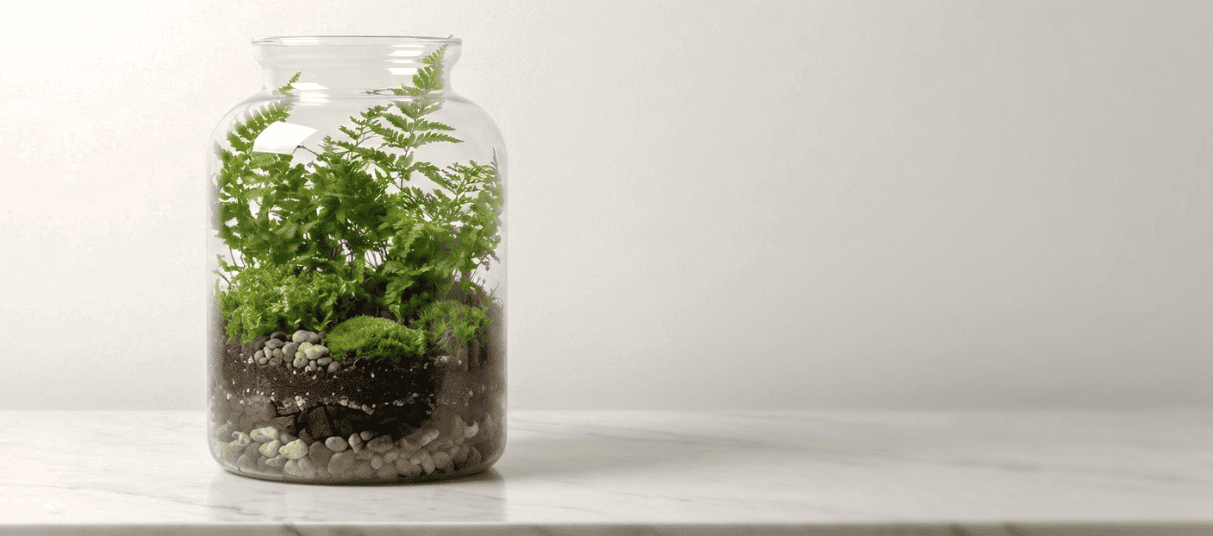
Whether you were naturally born with green thumbs, or if you’re just starting on your landscaping journey, a terrarium is the perfect way to bring a bit of verdure inside your home. These miniature ecosystems radiate tranquillity and are incredibly easy to care for. In this guide, we will walk you through how to design, build and maintain a thriving terrarium.
What is a Terrarium
A terrarium is essentially made of glass, housing a small ecosystem including soil, plants, and sometimes mosses or small decorations, inside a self-contained miniature climate. The beauty of a terrarium is that, once properly built, it will take care of itself, its moisture will recycle, humidity levels will stabilise, and maintenance will become minimal.
Planning Stage
– Container: Decide between an open or closed container, based on plant needs. Closed terrariums allow a natural water cycle to form, suited to ferns, mosses and tropical species, whereas open terrariums thrive on good air circulation, preventing the build-up of humidity, ideal for succulents, cacti and air plants. An unused aquarium or a large glass jar will make building and maintenance far easier, as narrow-necked jars or tiny bottles are challenging to plant and prune.
– Biotypes: Vivariums house animals or plants primarily for observation or research, simulating a specific habitat. Paludariums combine both terrestrial and aquatic elements within the same enclosure, mimicking a semi-aquatic habitat, such as marshes, commonly used to house amphibians. Desert terrariums are designed to replicate arid, dry environments, using sand and rocks for plants like cacti, and even some reptiles. Tropical terrariums mimic rainforest environments, creating humidity for certain plant types.
– Light: Most terrarium plants thrive in bright but indirect light, as direct sunlight may burn the contents inside the glass.
– Plants: Plan your sizing, with regards to plant growth, for example, Selaginella Kraussiana, a small fern-like bush, starts off small, and grows over long periods of time, reducing the amount of pruning and maintenance, as opposed to the large-leafed Pothos. An example of a closed, humid terrarium containing unified compatible plants would include the Nerve Plant (Fittonia Albivenis) with its colorful stripy leaves, the Baby Rubber Plant (Peperomia Obtusifolia), a slow-growing plant with adorable rounded leaves, and the Dwarf Creeping Fig (Ficus Pumila Quercifolia) for its textured wall or floor covering abilities. Other local plants, for different biotypes, could include the Polka Dot Plant (Hypoestes Phyllostachya), a humidity-loving plant with colorful leaves, the Maidenhair Fern (Adiantum Capillus-Veneris), as the delicate shade-loving plant, the Bird’s Nest Fern (Asplenium Nidus), as the soft, atmospheric focal point, and even Forest Moss used as ground cover.
– Placement: Tabletop terrariums are the most common, often used as decorations in living rooms or offices. Hanging terrariums are a unique, eye-catching feature that doubles as a functional space-saving alternative.
Building Your Terrarium
Thoroughly clean your container, washing it with warm soapy water and rinsing it well before letting it dry completely. For your drainage layer, at the bottom of the container, add a 2 – 5 cm layer of small pebbles, gravel or coarse sand. This layer will help prevent water from pooling around the plant roots. Adding an optional barrier, a thin mesh or a piece of porous fabric over the drainage layer, will prevent soil from seeping into the rocks over time. On top of the drainage layer, or barrier, add a thin layer of activated charcoal. This helps to absorb excess moisture, filter the air and water, and keeps mold and odors at bay, essential for the long-term health of the micro-ecosystem. Add a layer of light, well-draining potting soil or substrate, suitable for the type of plants you chose, adding enough to give roots some space to grow, usually a few centimetres, depending on plant size. Now the creative decorating can begin, so gently remove your plants from their nursery pots, dust off excess soil, and loosen roots if needed. Look for soils labelled for houseplants, and rocks, pebbles or decorative gravel can be sourced in local landscape supply shops. Using a spoon, chopstick or your fingers, make small holes in the soil layer of your terrarium, and carefully set each plant in, firming the soil gently around the roots. Get creative with the placements, for a natural look, place tall plants in the back, and the shorter ones close in front. Once the plants are in, you can even add decorative pieces, such as pieces of driftwood, aquarium gravel, or little figurines and shells. Be mindful of the spacing. Such elements add aesthetic charm and personality to your terrarium. If you opted for a humid, closed terrarium, place the lid or cover on your container to finish it off, or leave it uncovered for your succulents and cacti, and then you’ll have built your very own miniature ecosystem!
Caring for Your Terrarium
– Watering: Use filtered or rainwater if possible, tap water sometimes contains minerals that, over time, build up in closed systems. Closed terrariums create their own internal water cycle. As the moisture evaporates, it condenses on the glass, then drips back to the soil, so you may only need to add water every 4 – 6 weeks, or less, only if the soil or plants look dry. Check the soil for open terrariums weekly, and use a spray bottle to water gently. Signs of under-watering include dry soil or wilted and dried brown leaves.
– Cleaning & Pruning: Wipe the glass (inside and out) with a soft cloth or paper towel with a very mild vinegar solution to avoid mold. Avoid harsh cleaners that are harmful to plants, and remove dead or yellowing leaves promptly to prevent rotting.
– Ventilation: Even a closed terrarium benefits from occasional ventilation, especially if condensation builds. If your terrarium becomes overly cloudy, moisture levels may be too high, so leave the lid off until things settle.
A well-built terrarium does more than just beautify your space. It brings a slice of nature indoors, delivers a calming, green presence, and, with correct setup, needs only light, occasional care, and love. Whether you work away often or just love greenery and lack a large garden area, a terrarium offers a low-maintenance, elegant way to connect with nature. If you follow the simple steps above, choosing the right container, layering materials properly, and choosing fitting plants, your terrarium can thrive for months or even years.
To Nurture is Nature 🌿
🩵 Instagram: @chateauhomeandpetcare
🩵 Facebook: chateauhomeandpetcare